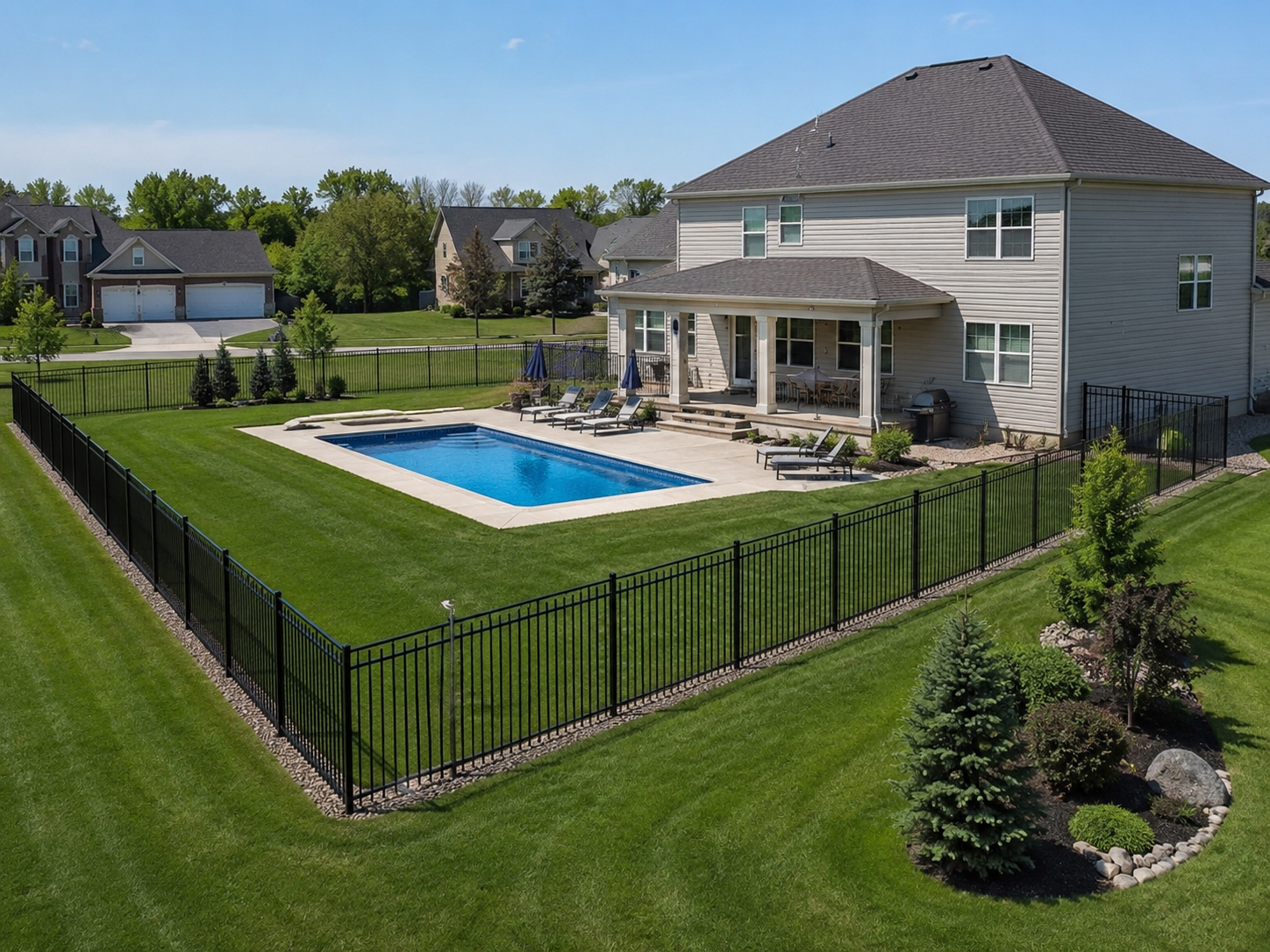
A pool fence has one job that outranks every other fence consideration on this site: keep kids out of the water when no adult is watching. Wisconsin's barrier rules exist for exactly that, and inspection day is just the moment somebody checks the fence did its homework.
Here's the practical checklist — what the rules require, what inspectors look at, and the walk-around you can do yourself this afternoon.
What Wisconsin barrier code requires
The fundamentals we build to on every pool fence:
- ✓A barrier at least 48 inches tall around the pool area.
- ✓Gates that self-close and self-latch — every gate, every time.
- ✓Gaps limited so a small child can't slip through or under.
- ✓Climbing-resistant design — no convenient ladder of horizontal rails on the outside face.
Those four ideas do almost all the safety work. Everything on an inspector's clipboard is some version of them.
The walk-around checklist
Height and gaps
Walk the full perimeter. Is the barrier 48 inches or taller everywhere — including where grade dips, mulch settled, or a landscaping bed raised the outside ground level? Check the gap under the fence and the spacing of pickets or mesh: tight enough everywhere that a toddler can't defeat it.
Gates: the part that fails
Open every gate to a few different angles and let it go. It should swing itself closed and latch — not sometimes, every time. A gate that self-closes from wide open but stalls from six inches is a failed gate. This is the single most common inspection problem, and the most important line on this page.
Hardware in a wet world
Poolside means splash, chemicals, and humidity. Check hinges for sag, springs for tension, and latches for corrosion or slop. Rust-proof hardware — the reason pool fences lean on powder-coated aluminum and coated fittings — is what keeps the self-latching promise alive in year five.
The gate path
A gate can only close if nothing stops it. Hoses, planters, toys, settled pavers that catch the bottom rail — clear the swing path and keep it clear. Inspectors notice; more importantly, so does gravity at 4 p.m. on a summer Saturday.
Why good pool gates go bad here
Wisconsin adds its own failure mode: frost. A gate post that heaves even slightly stops lining up with its latch — and a pool gate that doesn't latch isn't a pool barrier anymore. It's the same physics as any gate, with higher stakes. Our pool gate posts get set deep, in concrete, below the frost line, so the latch still catches in June.
Inspection logistics vary by municipality — who inspects, when, and how it's scheduled differ from town to town. Confirm your municipality's process before the pool opens for the season; we leave every pool fence inspection-ready regardless.
Materials that pass and keep passing
Powder-coated aluminum picket and tensioned safety mesh are the pool-barrier standards for a reason: inherently climbing-resistant profiles, rust-proof in the splash zone, and open enough to keep sightlines to the water — because watching the pool is the other half of pool safety.
Bottom line
Pass inspection by building to the code's actual logic: 48-plus inches everywhere, gates that latch themselves without exception, gaps a child can't exploit, hardware that survives poolside life. Then re-run the gate test every season like it matters — because it's the one item on this list that saves lives.
Pool going in, or barrier due for an upgrade? Get a free quote and we'll build it inspection-ready from day one.
Quick answers
What do pool fence inspectors check?
The fundamentals: barrier height (48 inches is the standard minimum), gates that self-close and self-latch reliably, gaps tight enough to stop a small child, and climbability — plus the overall condition of hardware in a wet environment.
Does every Wisconsin municipality inspect pool fences?
Requirements vary by municipality — most require a code-compliant barrier, and many inspect it. Confirm your town's process before the pool opens; we build to pass either way.
How often should I test a pool gate's latch?
Often — it's a safety item, not a formality. Swing the gate from a few different positions and confirm it closes and latches itself every single time, especially after winter and any hardware change.