Drive any county road in Northeast Wisconsin and you'll see split rail doing what split rail does best: making five acres look like a homestead. It's the fence people picture when they picture country property — and for some jobs it's exactly right. For others it's a handsome mistake.
We get asked about it often enough that it deserves a straight breakdown: where split rail genuinely fits, where it fails, and when a different fence does the same job cleaner.
What split rail is genuinely good at
- ✓Boundary definition: it draws a property line you can see from the road without walling anything off.
- ✓The look: nothing else says farmhouse, hobby farm, or acreage quite like it.
- ✓Long runs: with just rails and widely spaced posts, it puts less material per foot on the ground than almost anything, which matters across serious footage.
- ✓Open views: it defines the land while showing all of it.
Where it falls short
Containment: it doesn't
This is the big one. A split rail fence is a suggestion — dogs walk under or through it without slowing down, kids climb it in a heartbeat, and anything smaller than a horse ignores it entirely. It marks territory; it doesn't hold anything. Mesh fixes it, as covered below — but at that point you're pricing two fences stacked together, which is worth saying out loud.
Privacy: zero
Split rail hides nothing, blocks no sightline, and slows no wind. That's the charm on an open acreage view — and a dealbreaker anywhere you'd like the patio to yourself.
Rot: the built-in clock
Traditional split rail puts wood posts directly in the ground — at every single post. Wood-to-soil contact at the ground line is the classic fence failure in Wisconsin's wet, freeze-thaw soil, and split rail signs up for it across the whole run. It's the exact failure our builds avoid by putting galvanized steel in the ground instead of wood.
Rails wander
Rails rest in post pockets rather than fastening rigidly, and time works on that arrangement — rails sag, twist, pop loose in a storm, and occasionally walk off under a snow load. None of it is catastrophic; all of it is a running to-do list, multiplied by every rail on the property.
The maintenance math over a long run
Everything above multiplies by footage. A little rot at every post and a little wander in every rail is manageable on a decorative front section; across a full acreage perimeter it's a rolling project that never quite ends. Long runs are exactly where you want the fence that asks for the least — which is the strongest argument the metal options have.
The mesh-backed fix
The standard upgrade: welded-wire or woven mesh fastened along the back side. From the road it still reads farmhouse; up close it actually contains — dogs stay in, most critters stay out of the immediate yard. It's a genuine fix with honest costs: more material, more installation, mesh that needs to stay tensioned, and the rot clock still ticking on every post underneath. Done well, the mesh tucks behind the rails and reads as texture from thirty feet; done cheap, it sags between posts and reads as chicken wire — because it is.
Wind, snow, and open rails
Credit where due: split rail handles Northeast Wisconsin wind beautifully, because there's almost nothing for the wind to push on. Snow is less kind — a heavy, settling snowpack leans on rails all winter and finds the loose ones, and spring reveals which pockets let go. The mesh-backed version catches more wind and more drifting snow, which is worth knowing before the first winter rather than after it.
When an open metal fence does the job cleaner
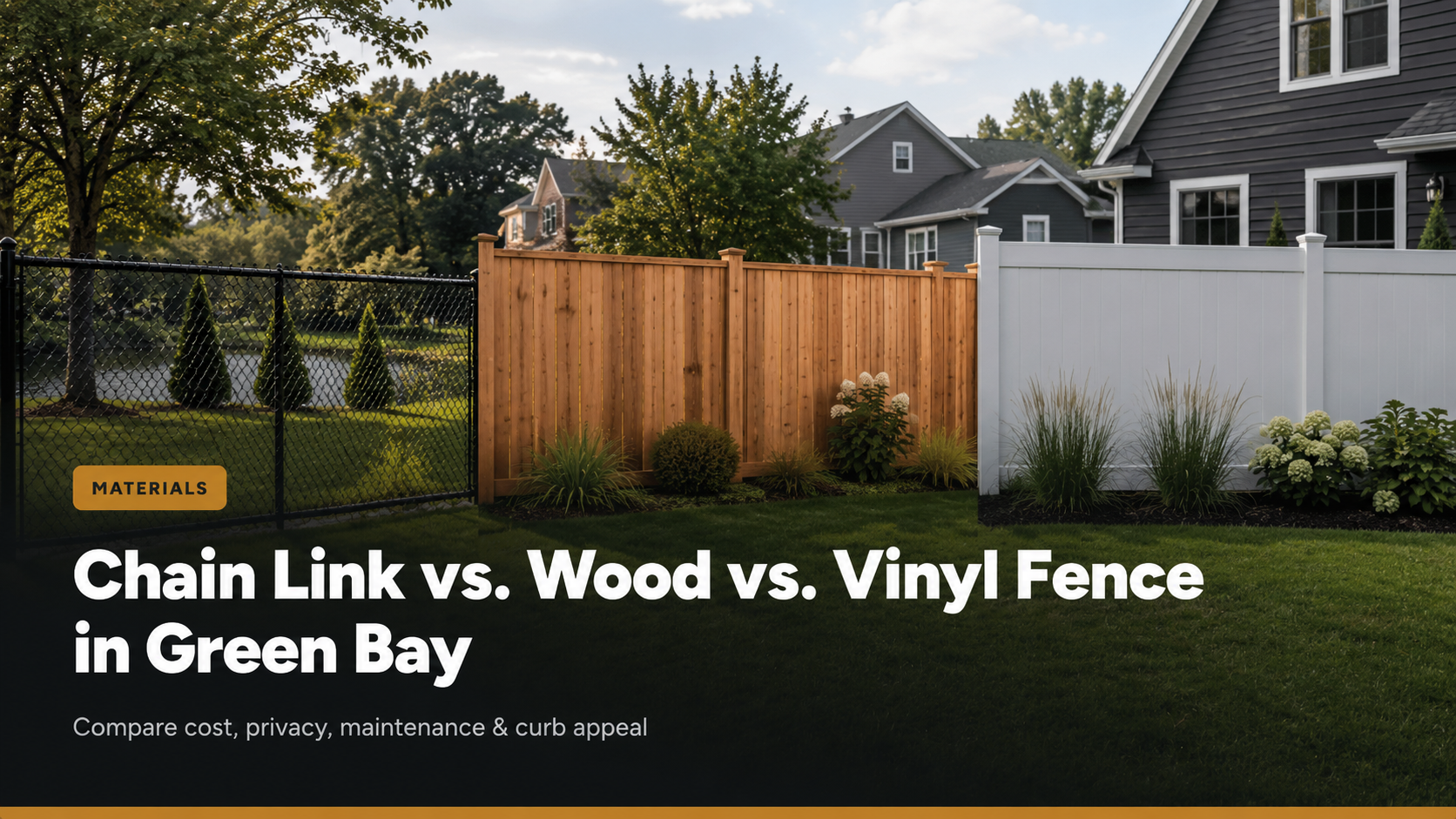
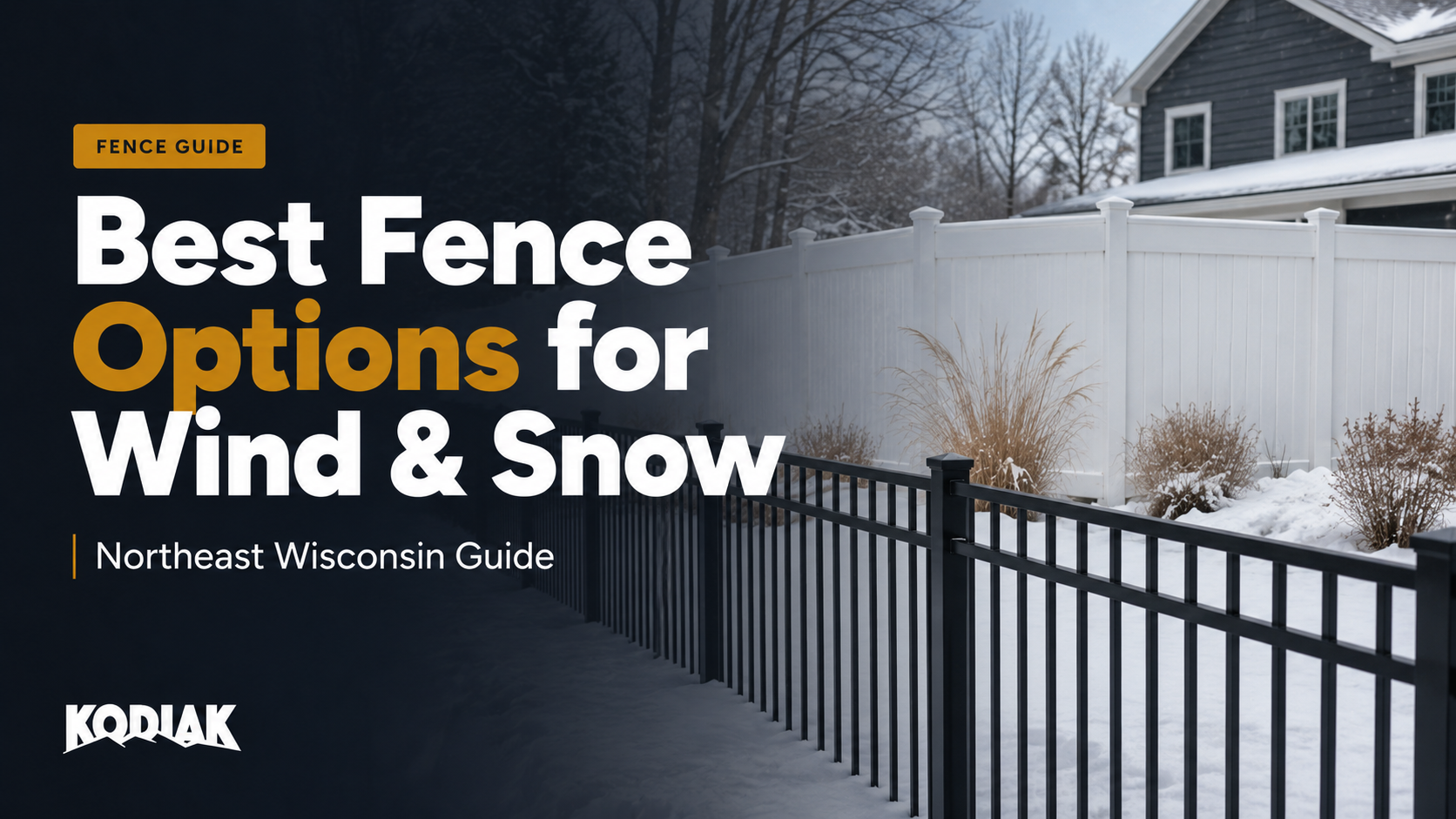
Be honest about the mission. If it's “define the acreage, contain the dogs, keep the view,” that's exactly the brief black chain link was born for — the dark mesh visually recedes at distance, contains everything with paws, and rides on steel posts that don't rot. If the front line deserves architecture, ornamental aluminum brings the estate look with a 30-plus-year lifespan. Both ride the land's dips and rises without complaint, and both treat a Wisconsin winter as a rounding error.
We compared those two head-to-head for big properties in our black chain link vs. aluminum guide — for most acreage briefs, one of them is the practical answer.
Our lineup is chain link, aluminum, wood privacy, and vinyl — we don't sell split rail. Which cuts both ways: you'll get a straight answer about whether an open metal fence truly covers your acreage brief, and an honest “that's not us” if the farmhouse look is non-negotiable.
Questions that settle it
- ✓Is anything alive supposed to stay inside this fence? If yes, split rail alone is out.
- ✓Who's doing the rail-and-post upkeep in year ten — you, or whoever you hire?
- ✓Is the look the mission, or a nice-to-have? Be honest; it changes the answer.
- ✓Would black mesh at fifty feet read close enough to open-country for you?
The honest recommendation
Choose split rail when the fence is scenery: boundary, curb appeal, the homestead look — and you accept the maintenance clock that comes with wood in the ground. Choose an open metal fence when the fence has a job: pets, kids, security, decades of service. Same open views, none of the walk-through problem. And if the property is big enough to split the difference — scenery fence along the road frontage, working fence around the yard — that hybrid is a legitimate answer too.
Bottom line
Split rail is a look with a job description too small for most families' actual needs. If the look is the whole point, it delivers. If containment is the point, mesh-back it — or skip straight to a fence that was designed to contain in the first place.
Fencing acreage this year? Get a free quote and we'll price the open options against your actual brief.
Quick answers
Does a split rail fence contain dogs?
Not on its own — the gaps between rails are wide enough for most dogs to walk straight through. Adding welded-wire or woven mesh to the back side turns it into a real containment fence while keeping the look.
Does split rail fencing rot?
Eventually, yes. Traditional split rail puts wood posts directly in the ground at every post, and wood-to-soil contact at the ground line is the classic fence failure in Wisconsin's wet, freeze-thaw soil.
What's an alternative to split rail that still contains pets?
Black chain link and ornamental aluminum both define an acreage boundary with an open, unobtrusive look while actually containing dogs and kids — no mesh retrofit required, and steel or aluminum in the ground instead of wood.